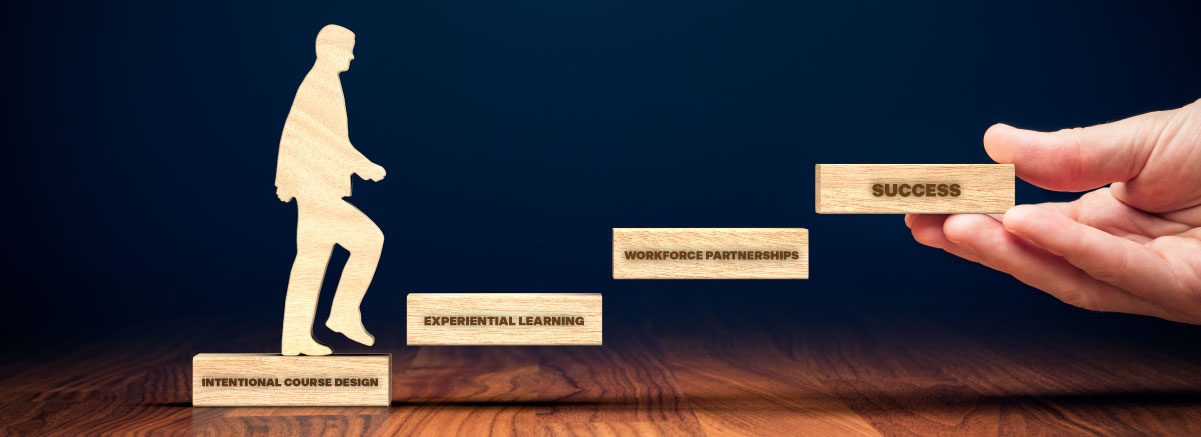
In conversations across higher education, there is increasing focus on outcomes. Graduation rates, placement data, and salary metrics are often used to define success, but there is growing recognition that measuring outcomes isn’t the same as delivering them.
In a recent episode of Illumination by Modern Campus, Dr. Edwin Blanton, Assistant Vice Provost for Corporate Initiatives and Business Development at the University of Texas at San Antonio, spoke to this distinction and what it requires from institutions moving forward.
As he put it,
“One of the things that institutions have to do is to stop treating career outcomes as this reporting exercise at the end and start treating it as a design principle.”
That idea reflects an important shift. Moving from simply talking about outcomes to actually delivering learner success requires rethinking how education is designed from the very beginning. Career readiness can’t be something added at the end of a program. It must be built in from the start.
Designing with the End in Mind
When career outcomes are treated as a design principle, institutions begin with a clear focus on where students are headed.
What should students know when they graduate? What skills should they have? What experiences will prepare them for the roles they want to pursue?
The answers to these questions are strongest when they are shaped in partnership with employers. Co-creating programs with employers allows institutions to align curriculum with real-world expectations. Employers can help define the skills they look for in new hires, the knowledge that is most relevant, and the competencies that set candidates apart.
This approach ensures that programs are not built in isolation, but instead reflect the realities of the workforce students are preparing to enter.
Expanding How We Think About Experiential Learning
A key part of this shift involves expanding the definition of experiential learning.
Experiential learning is often viewed as a single milestone, such as an internship at the end of a program. While internships remain important, they represent only one point along a much broader spectrum.
Experiential learning can and should take many forms throughout a student’s journey. Guest speakers bring industry insight into the classroom. Field trips expose students to professional environments. Job shadowing offers a closer look at day-to-day work, while informational interviews give students the chance to learn directly from someone already in the role they aspire to.
Even teaching students how to initiate those conversations matters. When a student connects with someone in their desired career and learns how they got there, it can shape their understanding of what’s possible.
Course-based projects, applied learning opportunities, and internships can all be embedded across a program. The goal is to create a continuous thread of real-world engagement rather than a single experience at the end.
Moving Beyond Silos to a Guided Journey
For many institutions, curriculum, student engagement, and workforce connection still operate separately. Students are often left to navigate these areas on their own, which can make their path feel fragmented.
A more effective model brings these pieces together into a single, guided experience.
Faculty, career services, experiential learning teams, and employers all play a role in shaping that journey. When they work in alignment, they can create scaffolded learning experiences that build over time and reinforce one another.
This kind of integration does not happen overnight. It requires intentional effort and strong collaboration. Much of that work comes down to building relationships across individuals and departments.
From Add-On to Institutional Culture
Another important distinction is how institutions approach employer engagement.
When employer engagement is confined to a single office, it often remains an add-on rather than a core part of the academic experience.
To create meaningful impact, employer-connected learning must be embedded across the institution. It should be present within academic departments, supported by faculty, and prioritized by leadership.
This requires shared ownership. Faculty, staff, and leadership all bring connections and insights that can help inform curriculum and create opportunities for students. Accountability ensures that those connections are maintained and used in ways that benefit learners.
When this work becomes part of the culture, it moves beyond isolated efforts and becomes a defining characteristic of the institution.
Building Meaningful Partnerships
As institutions strengthen employer engagement, the nature of those relationships also matters.
Transactional partnerships will always exist, but they are not enough on their own. The greater opportunity lies in building sustained relationships that allow institutions and employers to create together.
These partnerships support program design, inform teaching, and ensure that learning experiences reflect the current state of the workforce. They prepare students not for what work used to look like, but for what it looks like today.
What It Takes to Move Forward
Looking ahead, three factors will define how successfully institutions scale and personalize career-connected learning: mindset, infrastructure, and partnerships.
Mindset is the most critical. It requires a willingness to rethink long-standing approaches and redesign how education is delivered. This can feel uncomfortable and uncertain, but it is necessary to align with how today’s learners move between education and work.
Infrastructure is also essential. Institutions need systems to track skills, experiences, and outcomes. While this can seem complex, new approaches such as micro-credentials are making it easier to document and communicate skills in ways employers understand and value.
Partnerships tie everything together. Strong, ongoing collaboration with employers ensures that programs remain relevant and responsive to changing workforce needs.
The Role of Professional and Continuing Education
Professional and Continuing Education programs offer a strong example of this work in action.
These programs serve a wide range of learners, including those without a traditional degree, individuals looking to change careers, and professionals seeking advancement. Many already engage employers from the beginning, shaping programs based on what industries need.
In many cases, industry professionals are directly involved in teaching. This provides learners with current, practical insights and creates opportunities for hands-on learning that feel immediately relevant.
It also shows that experiential learning is not limited to traditional degree pathways. It can be embedded across all types of educational experiences.
The Lasting Impact of Experiential Learning
Experiential learning is powerful because it allows students to move beyond theory.
When learners engage in real-world experiences, reflect on those experiences, and apply what they have learned, they build skills, confidence, and clarity. This cycle prepares them to navigate an evolving workforce and continue growing over time.
It is not simply an enhancement to education. It is a critical component of preparing learners for meaningful careers.
Continuing the Conversation
Dr. Blanton’s perspective highlights a broader shift taking place across higher education. Institutions are moving beyond conversations about outcomes and focusing more intentionally on how those outcomes are created through design, experience, and collaboration.
Designing with the end in mind, embedding experiential learning throughout the student journey, and building meaningful partnerships with employers are all part of that shift. Together, they represent a more integrated approach to supporting learner success from education into career.
To hear more of Dr. Blanton’s insights on experiential learning and workforce alignment, listen to the full podcast conversation The Road From Classroom to Career.
It is a conversation that reinforces a simple idea. Meaningful outcomes do not happen by chance. They are built through intentional design, shared ownership, and a commitment to preparing learners for the world they are stepping into.
Author
Professional and Continuing Education Staff
As a continuing education incubator, Professional and Continuing Education (PaCE) delivers skills-focused, innovative programming that satisfies the fluid learning demands of life-long learners. The values of Innovation, Accessibility and Excellence are realized through a dedicated team of specialists with a combined 30 years of continuing education experience.