

Zeina Hijazi turns scholarship support into biomedical discovery
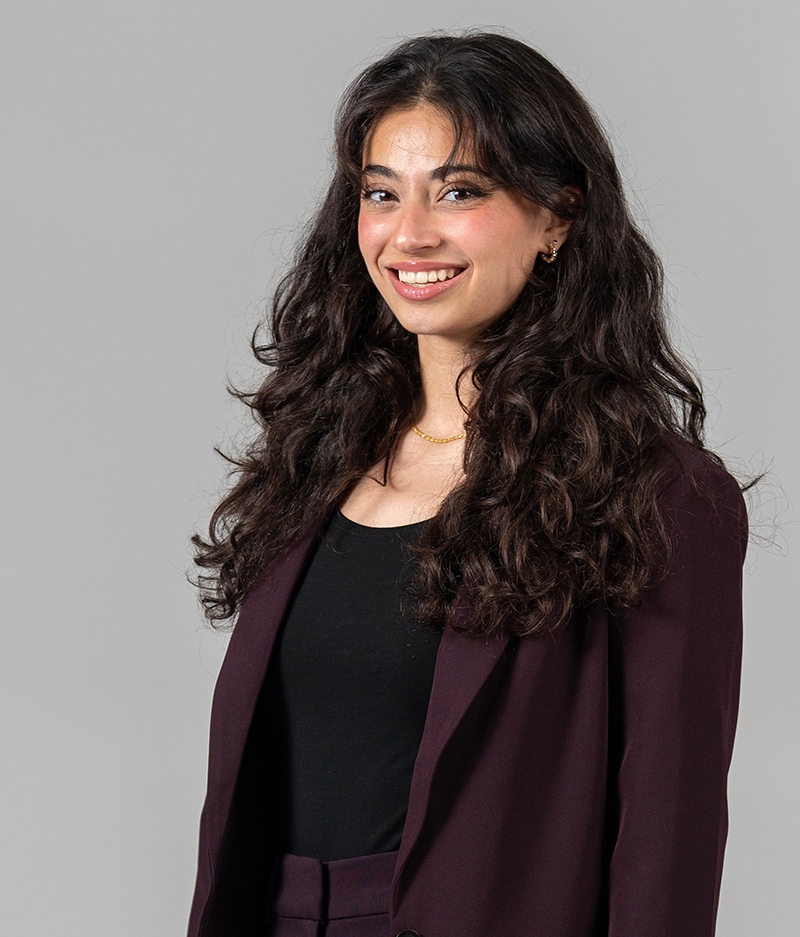 For Zeina Hijazi, pursuing a degree in biomedical engineering has always been about solving real problems and applying technology beyond the classroom. When weighing her college options, she was looking for an environment that would challenge her intellectually while allowing her to explore research with real-world relevance.
That search led her to The University of Texas at San Antonio, where a campus visit introduced her to the UT San Antonio Top Scholar program in the Honors College.
“I felt at home immediately,” Hijazi said. “There was a warmth and a sense of belonging that made me want to attend UT San Antonio, before I even knew whether or not I would be selected for the scholarship program.”
Now a junior majoring in biomedical engineering and a Top Scholar, Hijazi has built on that early sense of belonging through hands-on research, dedicated faculty mentorship and donor-supported opportunities that have helped clarify her academic and professional goals.
That foundation of support and opportunity led to one of the most defining moments of her undergraduate career during the summer after her sophomore year, when Hijazi conducted full-time research at Rice University. The opportunity was made possible through support from the Najim Center for Innovation and Career Advancement (Najim Center), which helped cover her living expenses in Houston and allowed her to fully commit to the experience.
“Support from the Najim Center didn’t just help financially,” she said. “It made it possible for me to say yes to an opportunity that completely changed my direction in life.”
During her summer experience at Rice University, Hijazi’s research focused on wearable electronics for rehabilitation, specifically exploring carbon nanotube threads that feel like fabric but can conduct electricity. Traditional muscle stimulation devices rely on adhesive electrode patches, which can be difficult to place and often require assistance. Together with a colleague who experienced paralysis following an accident, she co-developed the concept of a textile-based wearable that could deliver electrical signals directly to the skin without adhesives, creating a more comfortable and autonomous option for functional electrical stimulation therapy.
“There was a real person on the other end of the research,” she said. “Knowing this work could help someone changed how seriously I took my role as a student.”
While the prototype was early, the team demonstrated small muscle movement on the final day of the research project, showing the concept had real potential. For Hijazi, the true breakthrough came through persistence and trial and error.
“Ten weeks of failure taught me more than the final moment of success,” Hijazi said. “That process is what made me feel like a true scientist.”
In October 2025, Hijazi presented her research at the Roadrunner Experience Showcase, an annual event co-hosted by the Najim Center and the UT San Antonio Office of Undergraduate Research that highlights the impact of experiential learning. She advanced to the finalist round and earned second place overall, an achievement that affirmed both her work and her future goals.
“I went into the showcase with a good idea of what to expect, but the experience ended up being so much bigger than I imagined,” Hijazi said. “I met incredible people working on fascinating projects, and advancing to the finalist round was an unexpected affirmation. It was also the first time I looked at my work and felt genuinely proud of what I had accomplished.”
Following her expected graduation in Spring 2027, Hijazi plans to pursue a PhD in mechanical engineering with a focus on rehabilitation engineering and wearable technologies.
“I didn’t come to college thinking a PhD was even an option for me,” Hijazi said. “Being surrounded by supportive faculty and fellow students, along with the scholarship support I’ve received, reminded me that I wasn’t doing this alone, and that has made all the difference.”
By Jordan Allen
